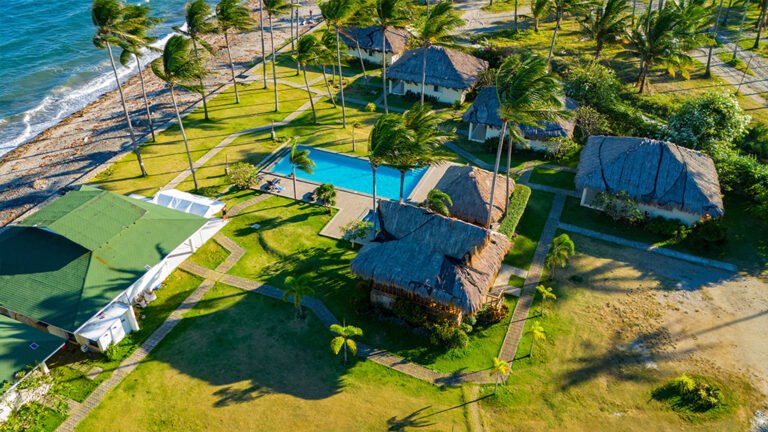
Foreigners cannot own land in the Philippines. They can, in the right structure, lease it. This article explains the national rules on long-term land leases: the statutes that apply, how a lease is registered on the title, and what to check before you sign. In a place such as Siargao, that often means a beachfront lot rather than a condo unit. For the wider picture of what foreigners can and cannot buy, start with our property overview.
Why foreigners cannot own the land
The 1987 Constitution reserves private land to Filipino citizens and to corporations or associations qualified to hold lands of the public domain, which means at least 60% Filipino-owned (Article XII, section 7). Source: 1987 Constitution.
Putting the land in a friend’s or partner’s name while you control it is not a workaround. The Anti-Dummy Law (Commonwealth Act No. 108, section 1) penalises, with imprisonment and a fine, a Filipino who holds land title for a foreigner, and any other fraudulent cover for a foreigner, not only nominee shares or management roles. The foreigner who profits is liable too.
Two lease tracks, not one
The Civil Code supplies the general law of lease. Under Article 1643, a lease of things is the enjoyment or use of a thing for a price certain, for a definite or indefinite period. No lease for more than ninety-nine years shall be valid. That ceiling sits in Article 1643 itself, not in Articles 1352 or 1409, which deal with contracts that have an unlawful cause, or that are inexistent and void from the beginning. Those articles can matter if a lease is used to evade the land-ownership ban, but they are not the source of the term limit.
On top of that general ceiling, special laws cap how long a foreigner may lease private land, and those caps depend on who the lessee is.
Qualified foreign investors are covered by the Investors’ Lease Act, Republic Act No. 7652, as amended by Republic Act No. 12252 (approved 3 September 2025). The original Act allowed a lease of up to 50 years, renewable once for not more than 25 years. RA 12252 rewrote that section. For a foreign investor with an approved and registered investment, the aggregate period of the lease must not exceed 99 years. Where a lease agreement under RA 12252 contains a renewal provision, renewal is not automatic or at the sole option of the foreign lessee; it requires mutual agreement between both parties. Furthermore, the foreign enterprise must continue to demonstrate tangible social and economic contributions to the country to maintain its statutory standing. The land must be used solely for that investment, and only as much of it as is reasonably required, subject to the Comprehensive Agrarian Reform Law and the Local Government Code. The lease must be registered with the Registry of Deeds and annotated on the title. Registration is what binds third persons (RA 12252, new section 4-A; PD 1529). If the registered investment is withdrawn, or the land is used for an unauthorised purpose, the lease can end by operation of law.
Tourism projects have an additional statutory investment condition under the Act. For tourism developments, such as resorts, boutique hotels, or destination infrastructure, RA 12252 attaches specific commercial conditions. The project must meet a minimum statutory investment threshold, with the majority of the project capital required to be infused within the first few years of signing the lease. Crucially, the land must be actively used for approved commercial tourism operations; leasing under the Act for purely private living or personal residential use is prohibited.
How the difference works
Under Article 1650 of the Civil Code of the Philippines, the general rule governing subleasing is permissive: when there is no express prohibition in the lease contract, the lessee has the default right to sublet all or part of the leased property. However, this right comes with secondary liability safeguards, as the sublessee remains bound to the principal lessor for all acts relating to the use and preservation of the property under Article 1651, and the lessor may directly collect rent from the sublessee up to the amount owed by the principal lessee pursuant to Article 1652. Additionally, for non-investor foreign lessees governed by Presidential Decree No. 471, a foreign lessee cap applies, restricting the maximum duration of both the underlying master lease and any derivative sublease to 25 years, renewable for another 25 years upon mutual agreement.
In contrast, subleasing under the Investors’ Lease Act (RA 7652, as amended by RA 12252) is subject to strict statutory qualifications and regulatory oversight. First, a sole and mandatory use requirement dictates that the leased land must be used exclusively for approved, registered foreign investment projects, such as industrial, commercial, agricultural, or qualified tourism enterprises, meaning any sublease must directly align with and support that registered investment activity. Second, the law enforces a strict prohibition on residential landholding, preventing foreign investors from using RA 12252 subleasing structures as a scheme for pure residential landholding, land banking, or unauthorized real estate speculation. Third, regarding third-party rights and annotation, any sublease created under an RA 12252 structure must be registered with the Registry of Deeds and annotated on the Transfer Certificate of Title (TCT) under PD 1529 to bind third parties. Finally, there is a severe statutory termination risk: if the land is sublet for an unauthorized purpose or if the primary investment registration is withdrawn, the master lease terminates ipso facto (by operation of law), causing any dependent sublease to immediately collapse alongside the main lease.
Foreigners who are not investing in the Philippines as the Act defines it remain under Presidential Decree No. 471 and other existing lease laws (RA 12252, amended section 5). PD 471 sets a maximum of 25 years, renewable for another 25 years by mutual agreement, for leases of private land to aliens or alien-owned entities not qualified to acquire private land. A contract that exceeds that limit is void from the beginning.
In short: the Civil Code’s 99-year ceiling is the outer general limit. A qualified, registered investment may use the Investors’ Lease Act for a term of up to 99 years in total. An ordinary foreign lessee is on the shorter PD 471 track. Do not assume a “99-year lease” is available just because someone used that phrase in a brochure.
Registering the lease and annotating the title
An unregistered lease may bind only the parties. Under PD 1529, sections 51, 54, 60 and 61, a lease of registered land is registered by filing the instrument with the Registry of Deeds and entering a memorandum on the title and the owner’s duplicate. It takes effect upon the title only from registration. For investor leases, RA 12252 makes that registration and annotation a condition of the statutory lease itself.
Checks before you sign
These checks apply in Siargao and on any other long lease of land.
- Title and owner. Obtain a certified true copy of the TCT from the Registry of Deeds or LRA eSerbisyo (eserbisyo.lra.gov.ph). Confirm the lessor is the registered owner, or holds a valid authority to lease, and read the annotations (mortgages, liens, adverse claims, existing leases).
- Tax declaration. Ask for the current tax declaration and check that it matches the title (RA 7160, section 202).
- Zoning and the CLUP. Confirm with the LGU that the intended use fits the zoning and the Comprehensive Land Use Plan. A lease does not authorise a use the land is not approved for. See also zoning clearance.
- Agricultural land and CARP. If the land is or may be agricultural, check coverage under the Comprehensive Agrarian Reform Program (RA 6657). Investor leases under RA 12252 are expressly made subject to that law.
- Coastal easement. On beachfront land, the Water Code sets a public-use easement along the shores of seas and lakes: 3 metres in urban areas, 20 metres in agricultural areas and 40 metres in forest areas, measured along the margin (PD 1067, Article 51). No building is allowed in that zone.
- Which lease statute applies. Is this an investor lease tied to a registered investment under RA 7652 as amended, or an ordinary lease under PD 471? The term, the use restriction and the registration conditions differ.
Have the contract reviewed before you sign: lease and rental contracts, property due diligence and deed preparation and contract review.
How a 60/40 Philippine corporation fits in
A domestic corporation that is at least 60% Filipino-owned may own private land. Foreign shareholders may hold the balance, up to 40%. That is a company-and-title structure, not a personal lease, and it has its own capital, control and reporting rules. See 60/40 corporation registration and company incorporation. If the Filipino shareholding is only a name on paper while the foreigner controls the land, the Anti-Dummy Law is again in play.
How ILA helps
ILA’s in-house licensed lawyers in the Philippines review land titles and lease contracts, check registration and annotation, and advise on whether an Investors’ Lease Act structure, an ordinary lease, or a properly organised Philippine company is the lawful route for your plans.
WhatsApp: +62 878 8811 9963 (wa.me/6287888119963)
Philippines site: ph.ilaglobalconsulting.com
Sources: 1987 Constitution, Art. XII s.7; Civil Code Art. 1643, 1352 and 1409; RA 7652; RA 12252; PD 471; PD 1529 ss.51, 54, 60-61; CA 108 s.1; PD 1067 Art. 51; RA 7160 s.202; RA 6657. This article is general information, not advice on any specific parcel or contract.
Last reviewed: 10 Nov 2026